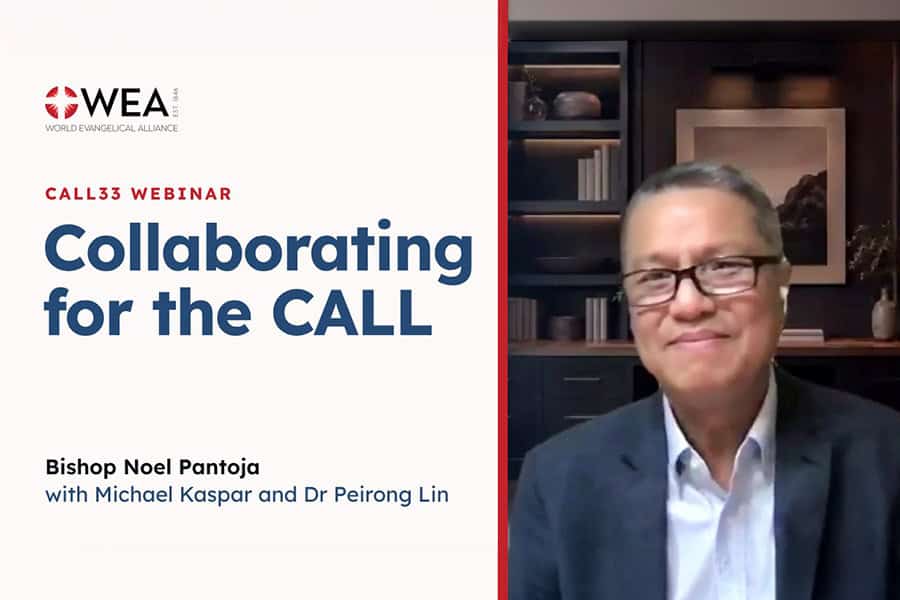
On 11 November 2026, the World Evangelical Alliance (WEA) held a webinar called “Collaborating for the CALL: Building Partnerships for Disciple-Making.”
The webinar looked at one question: how can churches and ministries in a nation work together to follow God’s calling?
There were two speakers:
- Bishop Noel Pantoja, National Director of the Philippine Council of Evangelical Churches (PCEC)
- Michael Kaspar, Director of Global Initiatives at Vision Synergy
Almost 300 people registered, and more than 120 leaders from around the world joined live. You can watch the full recording below.
What is CALL33?
CALL33 (Collaborative Alliance for Living the Lord’s Calling) is a WEA initiative. It asks each national evangelical alliance to pray and discover what God is calling the Church in their nation to do by 2033. WEA then connects alliances with partners who can help.
Kaspar asked if one church, denomination, or alliance could fulfill this calling alone. “If the answer is yes, it may be too small of a calling,” he said.
The story from the Philippines
PCEC started in 1964 with 11 churches and denominations. Today, it includes 91 denominations and more than 55,000 local churches.
Between 1970 and 2000, churches in the Philippines worked together to plant new churches. The number of evangelical churches grew from 5,000 to 51,300.
But PCEC learned an important lesson. “Planting more churches is not enough,” Pantoja said. “We must develop healthy churches that make disciples who make disciples.”
In 2023, PCEC leaders agreed to start a National Disciple-Making Campaign. The goal is for every church to be healthy, to make disciples, and to multiply.
The campaign has three parts:
- training conferences for pastors and church leaders
- clinics that help each church check its health and make a plan
- mentoring and coaching for churches over time
By October 2026, more than 18,000 pastors and church leaders had attended the training. More than 2,200 churches are taking part, and they have started about 6,600 small groups.
For Pantoja, success is not about how many people attend a conference. It is about how many believers are making disciples.
Three biblical principles
Kaspar used Ephesians 4 to show how the Church works together. Christ is the head, and every part of the body has its own work to do.
He shared three principles:
- Unity, not uniformity. We do not need to be the same to be united. Each church brings its own identity and calling.
- Diversity, not division. Our differences are gifts to share, not reasons to divide.
- Love you can see. Jesus said people will know His disciples by their love for one another (John 13:35).
“The world doesn’t read our strategy documents, it watches how we treat each other,” Kaspar said.
Pantoja agreed. Different denominations can keep their own identity and still work together. To do this, they must put their shared mission before their own interests.
How to start working together
Kaspar described three stages of working together:
- Explore: pray, listen, and find out who else cares about the same calling.
- Form: build trust, agree on a shared vision, and decide how to work together.
- Operate: work together, learn, and grow over time.
Many partnerships fail because they move too fast at the start, Kaspar said. Building trust takes time.
His advice is simple. Pray. Find two or three people who care about the same calling. Then talk with them, and ask one question: “Who else is God calling to this?”
Watch the webinar
You can also watch Michael Kaspar’s full presentation , download Michael’s Participant Notes, and download Bishop Noel Pantoja’s presentation slides (PDF).
Join a learning group on collaboration
Dr. Brad Smith, Director of Alliance Engagement at WEA, is planning an eight-week certificate program on collaboration. It will use resources from Vision Synergy.
The program could start in January or February 2027 if at least 10 national alliances join. Other organizations are also welcome.
If you are interested, please email Brad Smith at [email protected].