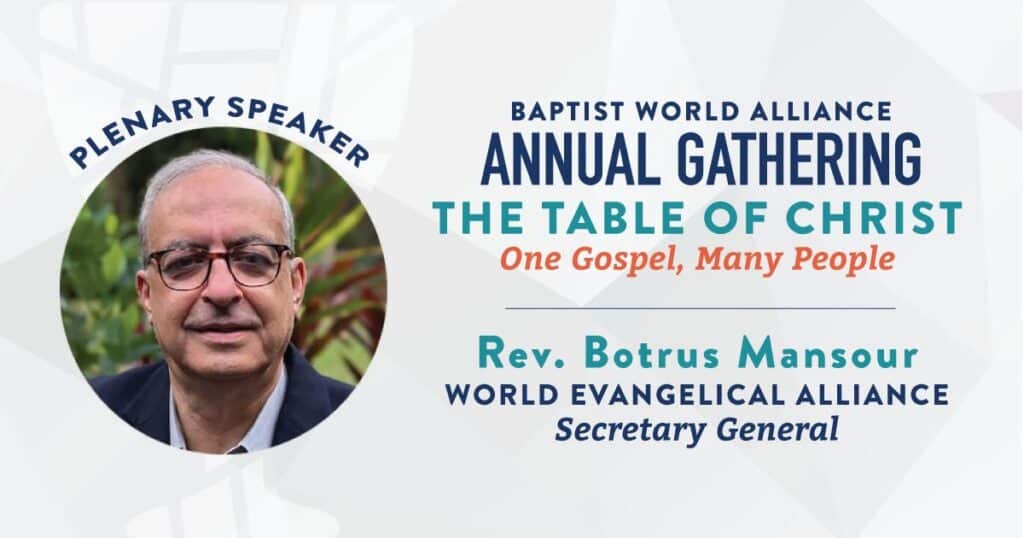
Toronto, Canada — “Unity is not something we merely admire—it’s something Christ creates at His table.”
With that conviction, Rev. Adv. Botrus Mansour stepped forward to address a global Baptist gathering in Toronto, Canada. Mansour was offering a vision for the years ahead—one rooted in Romans 15 and centered on the shape of Christian community.
In Toronto, Canada, Rev. Mansour—Secretary General of the World Evangelical Alliance (WEA)—delivered that conviction of years spent navigating faith across borders, congregations, and cultures. His presence as a keynote speaker placed him at the heart of the 2026 BWA Annual Gathering, scheduled for July 6–10, 2026, in Toronto, with organizers describing the event as both a moment of global fellowship and a turning point for the denomination’s future structures, including an inaugural Global Council.
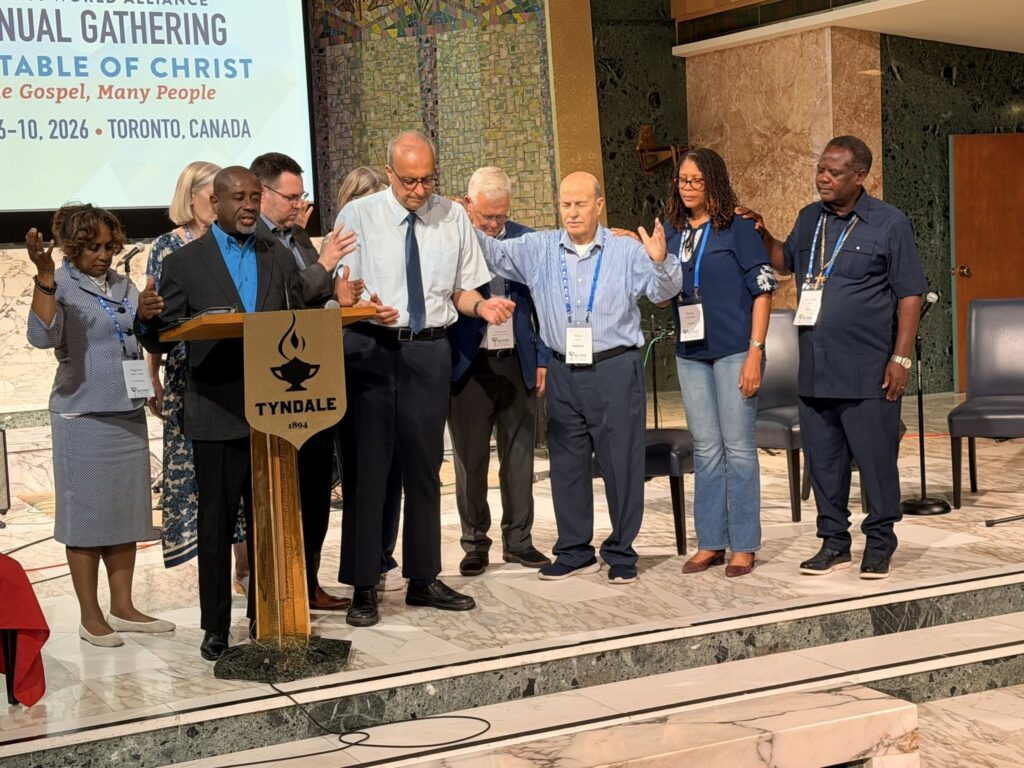
Mansour is a voice shaped by life and study in the Holy Land. Introduced by the Baptist organizers as an Arab Palestinian Israeli Christian minister, lawyer, writer, and administrator from Nazareth, Israel, he has carried the message of unity among believers and for religious freedom—an emphasis that shaped the message he brought to the gathering.
His remarks, titled “All Sitting at the Table of Christ,” drew from Romans 15:1–7, but the heart of the speech was not simply a theological explanation. It was an invitation into what he called the kind of community Christ forms—one built not by human status or political alignment, but by grace.
Before the message fully unfolded, Mansour framed the moment with reverence and excitement, saying, “The table of Christ… what a beautiful theme for a time like this.” He spoke of the Christian “table” as a place that gathers people who would never share a seat by any standard of prestige or human agreement, insisting that Christ’s welcome is what makes belonging possible.
He contrasted Christ’s approach with the logic of human empires. Where Rome sought unity through power, architecture, and dominance, Mansour described Jesus as forming a family through fellowship. He put it plainly: “Jesus made sinners into brothers and sisters through fellowship… around His table.” In his telling, the table is not an accessory to faith—it is the place where the gospel becomes visible in community.
The WEA leader, Rev. Mansour, emphasized that unity is never abstract. In his reading of Romans, he connects it to how believers treat one another and how that treatment becomes praise. He pointed to Paul’s logic—unity that leads to worship—stating, “He says that a certain action brings glory and praise to God.” For him, community becomes a form of doxology.
He then guided the audience through three movements of Romans 15: bearing with others, welcoming one another, and advancing together—each rooted in what it means to sit with Christ.
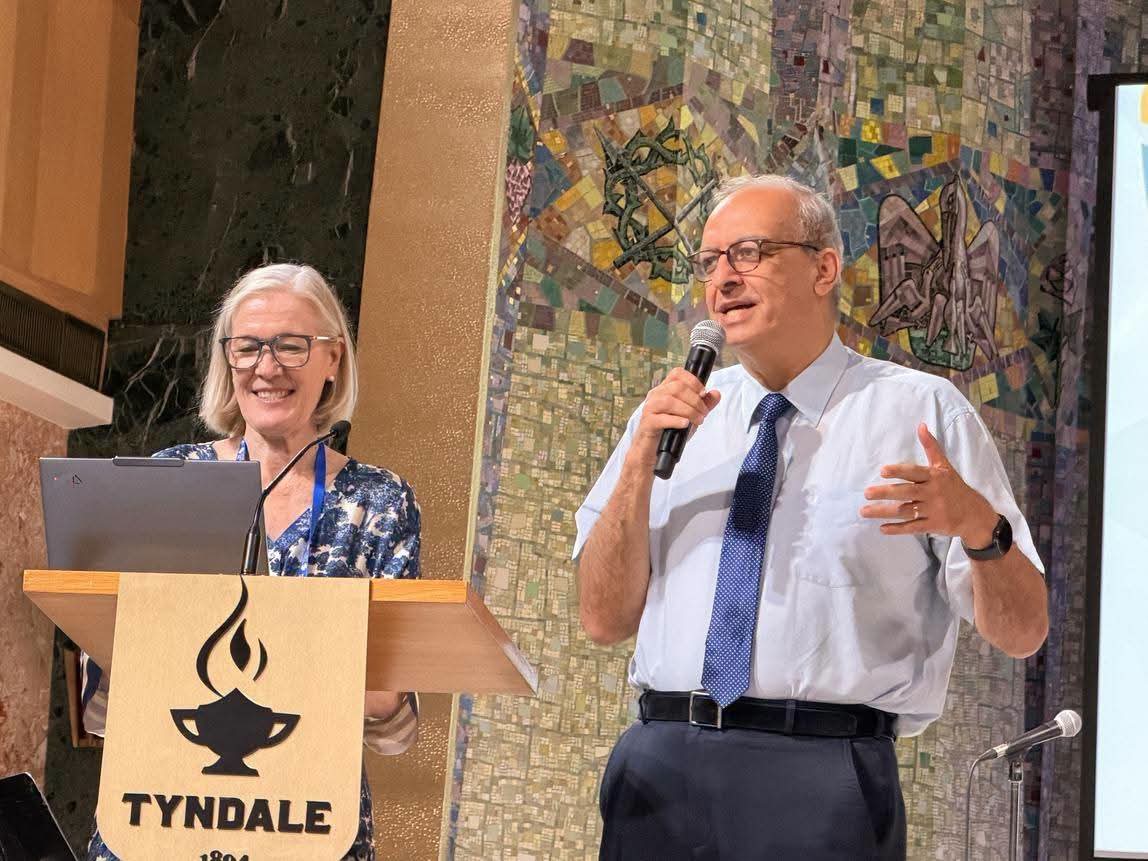
Mansour had began his talking by describing what it looks like when the “strong” are strong in a Christlike way—not strong enough to withdraw, but strong enough to carry. Mansour said, “At Christ’s Table the Strong will Bear the Weak.” He argued that this is an “upside down” expression of kingdom strength, borrowing language associated with Mennonite writer Donald B. Kraybill. In the world, strength often means independence and self-sufficiency. In Christ, strength exists for service.
To make the point concrete, he described the story of a paralytic and the teamwork required to bring him to Jesus. Mansour spoke as if he could see the different roles in motion—initiative, ability, navigation, encouragement, and follow-through—suggesting that ministry succeeds when support is shared, and effort is coordinated. He summarized the lesson with a line meant to land on the practical conscience of the church: “None of them could have accomplished the task alone.” In his view, this is what it means to reject isolation as a model for ministry.
He also offered a personal reflection connected to the reversal of roles—how, at one time, he had been carried by others and later had to learn what it meant to assist. That reflection reinforced the larger theme: the table is where roles are exchanged through compassion, not cemented through pride.
From there, he stressed that biblical acceptance is not a surrender of truth nor relativism. “Biblical acceptance is not relativism,” he said, emphasizing that Christ’s welcome does more than adjust opinions. It transforms people without flattening convictions.
He continued with a statement that captured the order he wanted the audience to remember: “Christ welcomed us. Then transformed us.” Welcome, in his framing, is both gift and process—Christ’s hospitality that leads to change, not compromise.
He connected the theme of the table to communion as well, describing it as a proclamation about more than death remembered. Mansour said, “Every time we celebrate Holy Communion, we proclaim more than Christ’s death. We proclaim His family.” For him, the Lord’s Supper is not simply an event; it is a public reminder that Christ’s table creates a people.

Mansour moved to advancing. He described “advance” as building up the church in ways that look different from solitary ambition. He argued that progress in the body of Christ is collaborative and communal. “Collaboration is not simply a strategy. It is theology,” he said, rejecting the idea that independent effort is automatically virtuous.
He warned against the selfishness that can hide inside individualism, adding that ministry belongs to God—not to personal agendas or the pursuit of credit. In other words, advancing the church is not about winning for oneself; it is about serving the same mission with shared responsibility.
Mansour grounded this in his own leadership context as Secretary General of the World Evangelical Alliance, describing it as a family serving in 164 nations and calling for cooperation across different national alliances. He spoke explicitly against dominance and against the assumption that one region’s vision must become everyone’s agenda. “We are making it a point that there is no hegemony. We don’t come with a Western agenda…” he said, challenging the audience to imagine a global partnership that does not reproduce old hierarchies in spiritual clothing.
Instead, he framed collaboration as mutual enrichment—local and global strengthening each other. “Everyone gives. Everyone receives.” The table, in this sense, is not a one-way line of benefit, but a shared posture of dependence and service.
As the speech drew toward its conclusion, Mansour returned to the outward-facing purpose of unity. He linked it to evangelism and witness, citing Jesus’ prayer in John 17 that believers “may be one.” Mansour declared the connection without hesitation: “Unity is evangelistic.” He argued that the world understands coalitions and diversity, but it does not yet recognize Christ-shaped unity—especially unity strong enough to gather people who would otherwise never sit together.
He closed the circle back to the image of the table itself, describing what unity should look like in tangible terms. “Around Christ’s table, there are no head tables and no back tables… It is a roundtable.”
For the leaders and churches looking ahead to Toronto 2026, Mansour’s message offered more than inspiration. It offered a way to measure the future: not only whether structures are built, but whether the people who sit within them reflect the table Christ creates. In a gathering expected to include fellowship and the practical “working out” of new frameworks—especially through an inaugural Global Council—his words served as both encouragement and challenge.
And in that Toronto room, the table became the story’s center: not a place for sameness, but a place where Christ makes strangers into family—and where unity becomes the gospel, seen.


Stay Connected