
Malta is a place of survival. It sits in the middle of the Mediterranean at the strategic narrowing of the sea. Trade winds lead ships to its coasts no matter the direction of travel. Two thousand years ago, a storm drove Paul away from the safety of Fair Havens on Crete. Two weeks later, the sound of the sea crashing against the rocks of the island did not announce safety, but dread. A shipwreck was coming.
I stayed near St. Paul’s Bay, the place where Paul is reported to have come ashore out of the jaws of the ocean into safety. The constant rhythm of pounding waves and the presence of watchtowers along the coast invited me to reflect on the lessons of Malta and what survival for the Church might look like in the days ahead.
Near the center of St. Paul’s Bay stands Wignacourt Tower. Its walls are 13 feet thick, and it rises nearly 60 feet above the water. It is the oldest watchtower on the island, built in 1610 by Grand Master Alof de Wignacourt of the Knights of Malta. It was not built to impress. It was built to be ready.
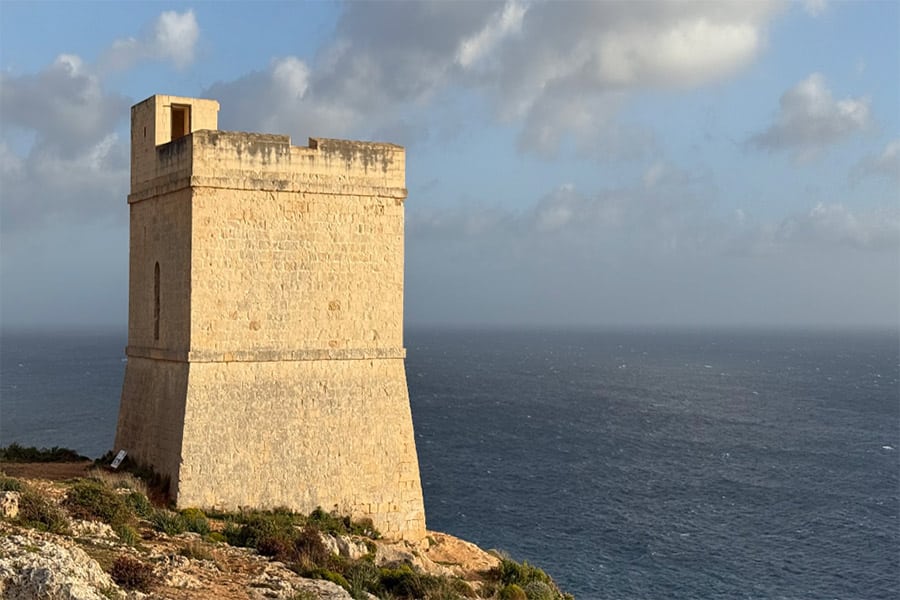
For centuries, Malta lived under the constant threat of Ottoman raids and Barbary pirates. The Knights constructed a network of coastal watchtowers, more than 30 of them, carefully positioned so that each could see the next. Together, they formed a chain of awareness that wrapped around the island. Their task was simple: watch the horizon, and if danger appeared, sound the alarm.
Smoke by day. Fire by night. Like the presence of God guiding the fleeing people of Egypt, the signal would travel from tower to tower until, within minutes, the entire island could be alerted. No tower stood alone. No tower carried the burden by itself. They watched together so that all could be protected.
Scripture places a similar calling on spiritual leaders. We are told to “keep watch over yourselves and all the flock” (Acts 20:28), and that leaders “keep watch over your souls as those who will give an account” (Hebrews 13:17). As we drove around the islands, we were never far from one of these towers. Some have disappeared into history, but many remain. None function as watchtowers anymore, though a few have become museums.
The image of the watchman in Ezekiel reminds me that seeing danger and failing to speak is not faithfulness. It is silence in the face of risk. The first role of leadership is to watch, to notice, to discern, and to lovingly sound the alarm when needed. At times, it seems to me that the Church has stepped away from this role. Instead of alerting the world to danger, we have too often adopted the ways of the world. Our prophetic voice has grown quiet.
How else can we explain the abandonment of truth? What allows us to remain silent in the face of crises such as Israel? Many who have heard of the suffering in Sudan and the Congo have likely heard it through the news, but not from the pulpit. There is famine, displacement, and deep spiritual need, yet too few calls for relief, justice, and compassion.
And yet, a warning only matters if people respond.
About a mile from the beach where Paul came ashore lies the center of Malta’s medieval salt production. By 1650, Malta had become a salt exporter. The Knights constructed a large salt production system made up of wide, shallow rock pans that drew in seawater. Sun and wind evaporated the water, leaving behind crystallized salt in the briny pools.
Salt was not a minor product in the ancient world. It preserved food, sustained long voyages, and made trade possible. A society without salt could not survive. The wide pans carved into the rock worked slowly and quietly. Seawater was drawn in, spread thin across the stone, and left under sun and wind until the water disappeared and crystals remained.
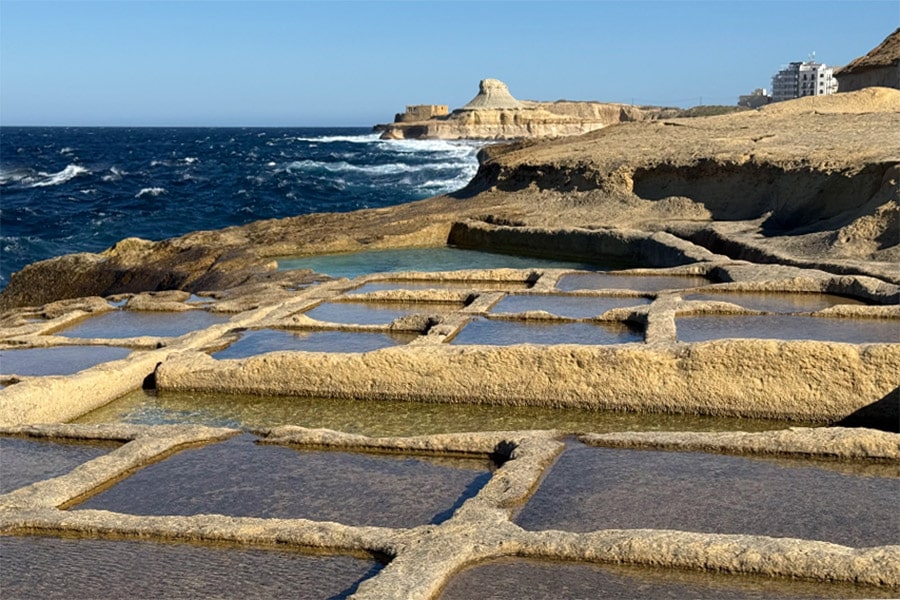
The work required patience and persistence, but the result was essential to life. It was hard for me to stand among those salt pans without hearing the echo of Jesus’ words: “You are the salt of the earth” (Matthew 5:13). Salt preserves what would otherwise decay. It gives flavor where life becomes dull. It makes possible what would otherwise spoil. The Church was never meant to withdraw from the world but to quietly preserve what is good, to bring the taste of the Kingdom into ordinary life, and to slow the spread of corruption by the steady presence of Christ’s people.
In the middle of these salt pans stands a simple stone cross, quiet and steady. A nearby display gives its name, Is-Salib tad-Dejma. Is-Salib means “the cross,” a word with Arabic roots shaped by centuries of Christian faith and spoken on a European island. Tad-Dejma refers to the local militia, the people called to defend the island.
As I stood there, it became clear that these salt pans were also a rallying place. When danger came, the villagers did not simply hear the warning and retreat into isolation. They moved toward something. They gathered.
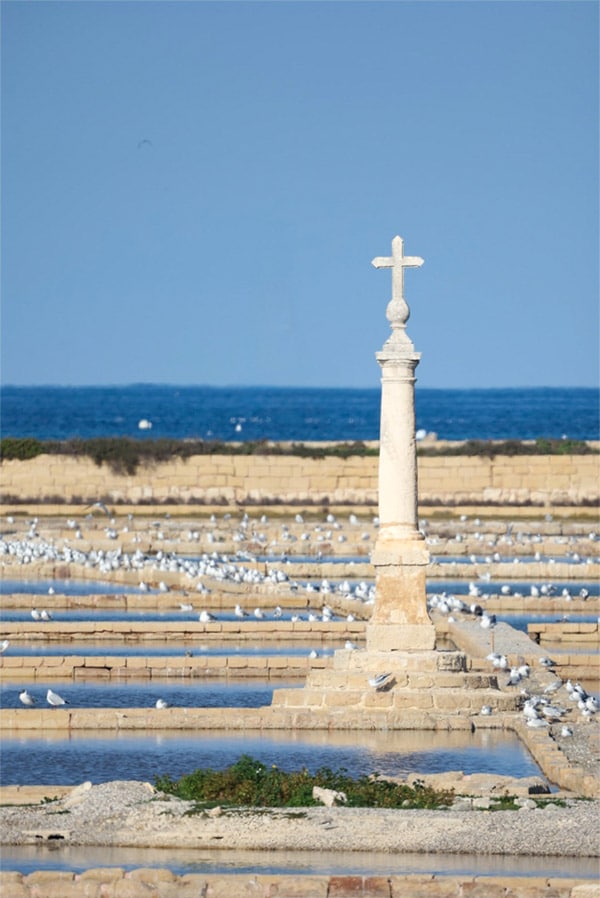
These were not professional soldiers. They were farmers, fishermen, and laborers, ordinary people living ordinary lives. When the signal was given, they left their fields and nets. They stepped away from their routines. They came together at the cross for mutual defense. And what stayed with me most was this: they had to lay down their differences.
In moments of real danger, there is no room for unnecessary division. A shoreline cannot be defended while arguments over preferences continue. An enemy cannot be resisted while people remain divided. The cross called them into unity, not uniformity, but shared purpose. Warning required vigilance. Defense required togetherness.
Standing there, I could not help but think about the Church. We are often aware of threats. We speak, write, and respond. In many ways, we are still building watchtowers. Yet too often our attention turns inward. Our concerns focus on other Christians with whom we disagree. We begin to treat other believers as the problem, but they are not the real enemy.
Scripture redirects my focus clearly. “For our struggle is not against flesh and blood, but against the spiritual forces of evil” (Ephesians 6:12). The danger is not one another. And the way we engage the battle must reflect the heart of Christ. The Kingdom does not advance through force, coercion, or dominance. It moves through love, humility, service, and truth carried in grace.
Jesus modeled this way and prayed for something both simple and profound. “That all of them may be one… so that the world may believe that you have sent me” (John 17:20–21). Unity is not a strategy. It is a witness.
The villagers of Malta understood something I think we easily forget. When the moment called for it, everyone came. Not just leaders. Not just specialists. Everyone. They gathered at the cross. Not at the marketplace of ideas. Not around personal preferences. Not in isolated corners. At the cross.
I was taught that the ground is level at the foot of the cross. Everyone is equal there. I was taught that as we draw closer to Christ, we draw closer to one another. The cross is what unifies us.
As the global Church looks to accelerate efforts toward completing the Great Commission by 2033, the need feels clear to me. We must rightly identify the enemy, and the family of faith must lock arms. We must take our places on the watchtowers again with clarity about the bondage of sin. We must rally at the cross and point to the liberating work of the death and resurrection of Christ. The unity Jesus prayed for must be lived out.
As the future unfolds and the shared mission comes into view, I believe the invitation remains to both watch and gather. To be attentive to the times and to move toward one another in Christ. The vision ahead is not simply about clearer warnings. It is about deeper unity.
So climb the watchtower. Pay attention. Pray. Discern. Then come down. Go to the cross. Call others to gather there.
Because the work ahead will not be carried alone. And it will not be sustained by effort alone. It will be carried by a people who have learned to gather in humility, to serve in love, and to stand together in Christ.


Stay Connected